Views: 0 Author: Site Editor Publish Time: 2026-09-02 Origin: Site

Abrasive waterjet technology gives fabrication shops the ability to cut through virtually any material without introducing a Heat-Affected Zone (HAZ). We differentiate between a pure waterjet and an industrial abrasive waterjet cutting machine. Pure systems use only pressurized water to slice soft goods like foam or rubber. Abrasive systems inject a hard aggregate, usually garnet, into the stream to erode dense materials like metal, stone, and glass. Facility managers and manufacturing engineers often struggle to evaluate whether the upfront capital and ongoing consumable requirements of waterjet technology make sense for their floor. Thermal alternatives like laser or plasma might seem faster, but they frequently require secondary finishing operations to fix hardened edges or thermal warping. Understanding the exact mechanical processes of a waterjet helps you accurately project maintenance downtime, operational expenses, and production capabilities. This guide breaks down the physics, component architecture, and operational realities of abrasive waterjets.
Cold-Cutting Mechanics: Abrasive waterjets do not cut via shearing or heat; they utilize a supersonic erosion process, acting as a "liquid grinding wheel" that combines highly pressurized water with garnet abrasive to grind through materials at a micro-level.
Pump Technology Dictates Operating Costs: The choice between an intensifier pump and a direct-drive rotary pump fundamentally alters your maintenance schedules, energy consumption, and overall expenses.
Consumables Drive Operating Costs: Abrasive consumption (typically garnet) and wear-part replacement (mixing tubes, orifices, high-pressure seals) account for the majority of the hourly operating cost.
Application Versatility: Because it induces no thermal distortion, the technology is equally viable for aerospace-grade titanium, thick steel plates, and acts as the standard CNC waterjet cutting machine for stone cutting and architectural glass.
To evaluate edge quality and cutting speed, you must understand how pressure, velocity, and abrasives interact to remove material. A waterjet relies entirely on accelerated erosion. It is a mechanical wear process operating at extreme velocities, far different from traditional saws that shear material or lasers that melt it away.
The process begins at the pump. It converts standard tap water into ultra-high pressure, ranging from 60,000 to 90,000 PSI. Pressure alone does not cut the material. The pressure must convert into velocity. Pressurized water travels through specialized high-pressure stainless steel tubing to the cutting head. It forces its way through a microscopic jewel orifice made of industrial diamond, ruby, or sapphire. These orifices typically range from 0.010 to 0.015 inches in diameter. This extreme restriction accelerates the water stream to speeds exceeding Mach 2 or Mach 3. The result is a needle-sharp, highly cohesive cutting stream exiting the orifice with immense kinetic energy.
After the water passes through the jewel orifice, it enters a precisely machined void called the mixing chamber. The water moves at supersonic speeds, creating a powerful natural vacuum inside this chamber. We call this the Venturi effect. The vacuum pulls abrasive particles from a nearby hopper down through a feed tube directly into the high-velocity water stream. The abrasive particles violently draw into the chamber and instantly mix with the water before entering the final stage of the cutting head. The standard abrasive used is 80-mesh almandine garnet, though finer 120-mesh garnet is used for smoother edge finishes on delicate parts.
The core physics rely on momentum transfer. The water acts merely as the delivery mechanism. As the abrasive particles enter the mixing tube, the water transfers a significant portion of its kinetic energy to the garnet. The water accelerates the abrasive particles to near-supersonic speeds before they exit the nozzle. Instead of a solid grinding wheel, this highly focused fluid-garnet mixture performs the actual micro-grinding of the material. The sharp edges of the garnet impact the workpiece, eroding it away particle by particle. This creates a clean, precise kerf, typically between 0.030 and 0.040 inches wide, without generating any localized heat.
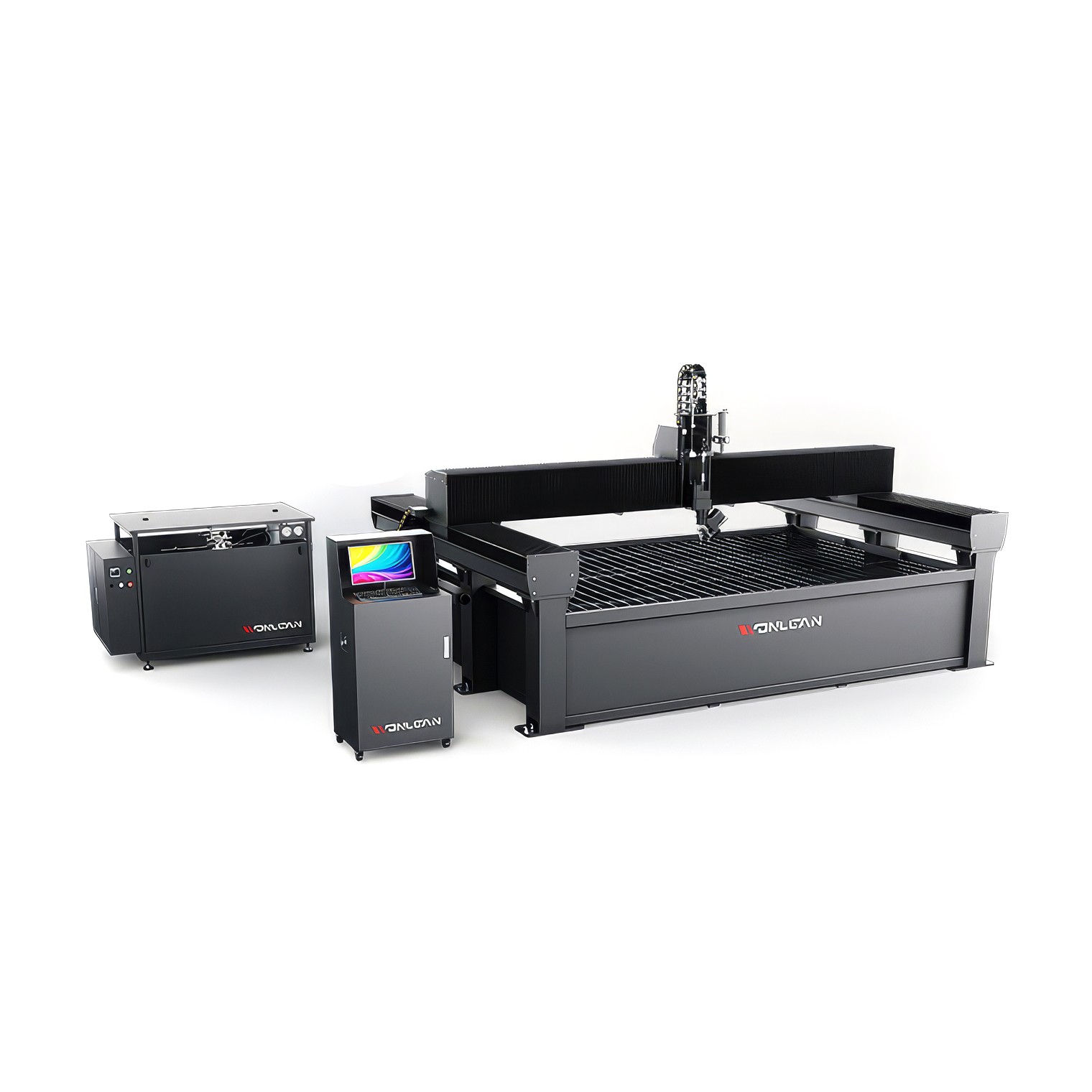
Breaking down the machine into its four critical subsystems allows you to evaluate hardware quality and vendor specifications. A reliable high pressure abrasive waterjet cutting system requires seamless integration between the pump, the cutting head, the abrasive delivery system, and the motion control platform.
The pump is the heart of the system. Choosing the right technology dictates your long-term maintenance approach.
Intensifier Pumps: These utilize hydraulic-driven linear mechanics. A large hydraulic cylinder pushes against a much smaller water piston. This multiplies the pressure based on the ratio of the surface areas. They are easier to maintain at ultra-high pressures like 90,000 PSI and easily run multiple cutting heads simultaneously. They have lower overall energy efficiency due to the hydraulic system's inherent heat generation and power loss.
Direct Drive Rotary Pumps: These rely on crankshaft-driven mechanics, similar to an automobile engine. A motor directly turns a crankshaft that drives three or more plungers to pressurize the water. They are highly energy-efficient, converting up to 95% of electrical energy into water pressure, and occupy a much smaller footprint. Historically, they were limited to lower operating pressures around 60,000 PSI, though modern engineering rapidly closes this gap.
The cutting head houses the most critical wear parts in the entire machine.
The Jewel Orifice: You must select the right orifice material. Ruby and sapphire orifices offer a lower upfront cost but have a shorter operational lifespan, typically lasting 40 to 60 hours. Diamond orifices require a significantly higher initial investment but deliver superior longevity, often lasting over 500 hours, while maintaining excellent stream cohesion.
Cross-Sectional Wear Dynamics: The internal flow path includes the mixing chamber and the carbide mixing tube (nozzle). As the abrasive travels through the mixing tube, it slowly wears away the inner diameter. The degradation of these wear parts directly impacts your cut tolerance, kerf width, and edge quality. Operators must monitor this wear and rotate or replace the tube to maintain precision.
Abrasive delivery must be flawlessly consistent. The system moves garnet from a large bulk hopper located near the machine to a smaller mini-hopper mounted directly on the Z-axis carriage. Continuous, moisture-free abrasive metering prevents clogs. If ambient humidity or splashing water enters the abrasive line, the garnet clumps. This leads to immediate clogs in the mixing chamber, resulting in inconsistent cuts, ruined materials, and unexpected machine faults. Operators must ensure the compressed air pushing the abrasive remains completely dry.
The X-Y-Z gantry system provides the physical movement, while modern CAD/CAM software serves as the brain. The software translates complex vector files directly into computer-controlled machine movements, optimizing the cutting path to reduce cycle times. Advanced kinematics feature 5-axis cutting heads. These articulating heads handle taper compensation. By slightly tilting the head during the cut, the machine eliminates the natural V-shape of the waterjet kerf, producing a perfectly perpendicular edge. This 5-axis capability also enables complex 3D part fabrication, allowing operators to cut bevels, countersinks, and weld preps directly on the machine.
Matching machine capabilities to specific industry requirements ensures you deploy the technology where it provides the highest return. The versatility of a waterjet cutting machine is vast, but it is not a universal solution for every material.
The primary advantage for metal fabrication is the zero HAZ. When cutting aerospace-grade titanium, Inconel, and hardened tool steel, thermal cutting methods alter the metallurgical properties of the edge. Lasers and plasmas cause warping, micro-cracking, or edge hardening. This ruins the part or requires hours of secondary machining. Abrasive waterjets cut these exotic alloys cold, leaving the material's temper and internal structure completely unaffected. Shops routinely cut 6061-T6 aluminum and AR400 steel plates up to 6 inches thick with excellent edge finishes.
In the architectural sector, operators utilize low-pressure piercing capabilities to start cuts in brittle materials. By dropping the pressure to around 15,000 PSI during the initial pierce, the machine prevents cracking, chipping, or delamination. Once the material is pierced, the pressure ramps back up for full-speed cutting. This makes it the ideal method for fabricating custom granite countertops, intricate marble floor inlays, and thick laminated architectural glass.
Modern manufacturing relies heavily on advanced composites. Waterjets cleanly cut carbon fiber, fiberglass, and Kevlar panels. Unlike routers that cause fraying or lasers that melt the resin matrix, the waterjet slices cleanly through the fibers. You must correctly calibrate the pressure and abrasive flow to prevent water from forcing its way between the composite layers. When dialed in, the edge quality is exceptional, requiring zero post-processing.
You must identify what a waterjet cannot cut to prevent catastrophic material failure.
Tempered Glass: You cannot cut tempered glass with a waterjet. The glass contains massive internal stresses created during the tempering process. The moment the high-pressure stream pierces the surface, the stress releases, and the entire pane shatters into thousands of pieces.
Hollow Honeycomb Structures: Certain aerospace honeycomb panels trap water inside their internal cavities. The immense pressure causes the facing sheets to blow out or delaminate from the core structure.
Moisture-Sensitive Materials: Materials that degrade, warp, or dissolve when exposed to water, such as certain untreated woods or specific paper-based composites, are poor candidates for this technology unless specialized protective masking is applied.
Purchasing the right system requires weighing upfront specifications against long-term operational realities. You must look beyond the initial specifications and evaluate the ongoing efficiency of the machine.
The industry standard is 60,000 PSI, but 90,000 PSI systems are increasingly common. You must analyze the trade-off. A 90k PSI system cuts significantly faster and uses less abrasive per inch of material cut, which benefits thick metal applications. However, the extreme pressure drastically increases pump wear, shortens seal life, and requires a higher initial capital investment. A 60k PSI system has lower maintenance requirements and longer intervals between pump rebuilds, but it consumes more abrasive over time and cuts slower.
Specification | 60,000 PSI System | 90,000 PSI System |
|---|---|---|
Cutting Speed | Standard baseline speed. | Up to 30-50% faster on thick materials. |
Abrasive Consumption | Higher usage per inch cut. | Lower usage per inch cut. |
Maintenance Frequency | Longer intervals between seal replacements. | More frequent high-pressure seal rebuilds. |
Pump Wear | Standard wear on check valves and cylinders. | Accelerated fatigue on high-pressure components. |
To calculate your true hourly rate, you must break down the ongoing expenses.
Consumables: Calculating the hourly usage of garnet is mandatory. Abrasive is the largest ongoing expense in waterjet cutting. Depending on your feed rate, you consume a pound or more of garnet every minute.
Power and Water: Track your utility consumption rates. Large intensifier pumps draw significant electrical amperage. You also pay for the water entering the pump and the water required for the cooling system.
Wear Parts: Budget consistently for mixing tubes, jewel orifices, and high-pressure pump seals. These are not optional replacements; running worn parts destroys cut quality and damages the cutting head housing.
Assessing your facility is the final step in the evaluation.
Determine your available floor space, keeping in mind that you need room for the machine, the pump, the bulk abrasive hopper, and safe operator access.
Evaluate foundation requirements; heavy gantries require vibration isolation to maintain tight cutting tolerances.
Plan your utility drops carefully. You need a clean water supply with adequate pressure.
Install specific high-voltage electrical drops for the pump.
Provide clean, dry compressed air to operate the pneumatic valves.
Addressing the hidden operational challenges of waterjet ownership before installation prevents unexpected downtime and costly repairs.
The quality of your incoming tap water directly dictates the lifespan of your high-pressure components. Hard water containing high levels of dissolved solids (TDS), calcium, or silica destroys high-pressure seals and jewel orifices rapidly. You must test your water prior to installation. If your water is hard, you must install commercial water softeners. In extreme cases, a reverse osmosis (RO) system purifies the water before it enters the pump. Chillers maintain pump integrity by keeping hydraulic fluids and incoming cutting water at optimal operating temperatures.
Abrasive cutting generates a massive amount of waste. Spent garnet and the eroded kerf material fall into the machine's catch tank, creating heavy, dense sludge. You must evaluate how you will remove this. Manual clean-out requires stopping production, draining the tank, and shoveling out the heavy sludge by hand. Automated abrasive removal systems continuously extract the sludge into a secondary hopper, eliminating this downtime. You must discuss environmental regulations regarding disposal. If you cut hazardous materials like lead, beryllium, or certain heavy metals, the resulting sludge is classified as hazardous waste and requires specialized disposal protocols.
Abrasive waterjets are loud and powerful industrial tools. Operating in open air, the cutting process routinely exceeds 90 decibels, requiring hearing protection for all nearby personnel. You can implement underwater cutting techniques to mitigate noise significantly. By raising the water level in the tank to submerge the material, you muffle the sound and eliminate messy splash back. Install physical safety guarding, light curtains, and emergency stop protocols around the work envelope to protect operators from the high-pressure stream and the rapidly moving gantry.
An industrial abrasive waterjet cutting machine remains unmatched in material versatility and cold-cutting precision. It empowers fabrication shops to take on a massive variety of jobs, from delicate architectural glass to thick aerospace titanium. Successfully integrating this technology requires a rigorous assessment of your operating expenses, facility utilities, and maintenance infrastructure to ensure long-term profitability. Base your vendor selection on pump reliability, the usability of the CNC software, and the availability of local service technicians. Software that features automated taper compensation is non-negotiable if you plan to cut high-tolerance parts for aerospace or medical applications.
Take the following steps to move forward with your evaluation:
Conduct a comprehensive time-study and cost-per-part analysis with prospective vendors using your specific CAD files.
Send samples of your most difficult material grades to the vendor for physical test cuts to verify edge quality.
Audit your facility's water quality and electrical capacity to determine the exact pre-treatment and utility upgrades required.
Validate your return on investment based on realistic abrasive consumption rates and maintenance intervals before issuing a final RFQ.
A: A pure waterjet uses only a highly pressurized stream of water to cut soft materials like foam, rubber, paper, and food products. An abrasive waterjet injects hard particles, typically garnet, into the water stream. This creates a powerful micro-grinding action capable of cutting dense, hard materials like steel, titanium, glass, and stone.
A: Most standard industrial systems effectively cut metals, plastics, and stone up to 6 to 8 inches thick. Specialized high-pressure systems cut materials exceeding 10 or even 12 inches in thickness. The cutting speed decreases significantly as the material thickness increases, requiring slower feed rates to maintain edge quality.
A: Tempered glass cannot be cut because its internal stresses cause it to shatter immediately upon impact. Certain advanced ceramics are too hard to cut efficiently. Hollow honeycomb structures are generally avoided because the high water pressure causes internal delamination, trapping water and blowing out the facing materials.
A: Operating expenses vary based on pump pressure, abrasive flow rate, and local utility rates. The vast majority of the hourly expense comes from garnet abrasive consumption. The remaining expenses are split between wear parts like mixing tubes and orifices, electricity to run the pump, and water consumption.
A: The cutting stream naturally loses kinetic energy as it penetrates deeper into the material, creating a slight V-shaped taper. Modern machines fix this using 5-axis cutting heads and advanced software. The system automatically tilts the cutting head slightly to compensate, leaving a perfectly straight, perpendicular edge on the part.
A: Yes, garnet can be recycled, but it requires specialized abrasive recycling equipment. The recycling process washes, dries, and screens the used abrasive to remove kerf material. The garnet particles fracture during the first cut, meaning the recycled abrasive is smaller and slightly reduces cutting speeds upon reuse.
A: Routine maintenance includes replacing consumable wear parts like jewel orifices and carbide mixing tubes. High-pressure pump seals require periodic rebuilding based on hours of operation. Operators must manage water quality filters, check hydraulic fluids, and regularly remove spent abrasive sludge from the catch tank to prevent overflow.