Views: 0 Author: Site Editor Publish Time: 2026-08-31 Origin: Site

Fabricators and machine shops eventually hit a production bottleneck when scaling operations. Processing thick plate materials efficiently without compromising edge quality or structural integrity remains a constant challenge on the shop floor. Investing in industrial cutting equipment requires balancing upfront capabilities with operational realities. Choosing the wrong technology for thick materials leads to secondary machining, thermal distortion, and restricted material versatility. You need equipment that aligns perfectly with your production demands.
This guide provides a technical, evidence-based comparison between laser systems and cold-cutting alternatives. We establish clear thickness thresholds, evaluate performance metrics, and define the exact use cases where each technology yields the highest return. Understanding the physical limitations of both thermal and cold cutting processes allows you to optimize your shop floor for maximum throughput and precision.
Thickness Thresholds: Laser cutters excel in speed and precision for thin sheet metals (typically under 1 inch), while waterjets dominate thick plate processing, capable of cutting metals up to 10–12 inches thick.
Thermal Impact: Lasers are thermal cutting tools that create a Heat-Affected Zone (HAZ), potentially altering material properties; waterjets utilize a cold-cutting process, preserving the metallurgical integrity of thick and sensitive alloys.
Material Versatility: While fiber lasers are highly optimized for specific metals, waterjets can cut virtually any material, including reflective metals, composites, and non-metals.
Operational Economics: Lasers offer lower per-part costs on high-volume, thin-gauge runs, whereas waterjets eliminate secondary finishing costs on thick, complex parts, offsetting their slower cutting speeds.
Establishing baseline requirements before evaluating machinery prevents costly missteps. Fabricators must audit their current and projected production mix. You cannot rely on industry averages. You must look at your specific daily operations. Identify the exact materials crossing your floor and the tolerances your clients demand. A shop processing 0.125-inch mild steel has vastly different needs than a facility cutting 4-inch titanium forgings.
Evaluating machinery requires a hard look at several critical dimensions. You must weigh these factors against your facility's capabilities and your operators' skill levels. Consider the following parameters when auditing your production floor:
Maximum and average material thickness processed monthly across all shifts.
Tolerance requirements and acceptable kerf widths for your typical parts.
Tolerance for secondary operations, such as grinding off dross or machining hardened edges.
Material diversity, including carbon steel, stainless, aluminum, titanium, and composites.
Production scale expectations, balancing small machine shop versatility against high-volume industrial output.
Positioning laser and waterjet against alternative methods clarifies decision-making. Fabricators often consider plasma or Electrical Discharge Machining (EDM) for thick metals. Plasma offers fast cutting speeds on thick plates. However, it yields poor edge quality, a wide kerf, and a massive heat-affected zone. You will spend significant time on secondary finishing when using plasma for precision parts. Operators must manually grind away the dross and hardened edges before the part can move to the welding or machining stations.
EDM provides unmatched micro-precision for thick, conductive metals. It cuts with extreme accuracy, often holding tolerances in the tenths of a thousandth of an inch. Yet, EDM is exceptionally slow. It cannot keep up with standard production quotas for general fabrication. Laser and waterjet represent the optimal middle ground. They balance speed, precision, and edge quality for modern manufacturing environments.
Cutting Technology | Primary Advantage | Primary Limitation | Best Use Case |
|---|---|---|---|
Plasma | High speed on thick plates | Poor edge quality, massive HAZ | Heavy structural steel, non-precision parts |
EDM (Wire) | Extreme micro-precision | Exceptionally slow cutting speed | Tool and die making, aerospace components |
Fiber Laser | Unmatched speed on thin gauge | Thermal distortion on thick plates | High-volume sheet metal fabrication |
Waterjet | Zero HAZ, extreme thickness capacity | Slower linear cutting speeds | Thick plates, exotic alloys, composites |
Understanding how lasers cut metal reveals their inherent limitations with thick materials. Lasers use focused light and assist gases to melt and blow away material. The process relies entirely on thermal energy. The beam must maintain a tight focus to vaporize the metal efficiently. When the material gets too thick, the physics of focused light become a liability on the shop floor.
Fiber lasers have largely replaced CO2 lasers for metal cutting. Fiber technology uses solid-state diodes to generate the beam. This beam travels through a fiber optic cable directly to the cutting head. The resulting wavelength is much shorter than a CO2 laser. Metals absorb this shorter wavelength much more efficiently, allowing for rapid melting and vaporization.
CO2 lasers use a gas mixture to generate the beam. They require complex mirror systems for beam delivery, which fall out of alignment and require constant cleaning. They consume more power and require more maintenance. Fiber lasers dominate modern metal fabrication because they offer superior energy efficiency and faster cutting speeds on thin to medium-gauge metals. However, even the most advanced fiber lasers hit a physical wall when material thickness increases.
Lasers face a strict physical barrier around the 1-inch mark. The issue lies in focal length limitations and beam divergence. A laser beam is shaped like an hourglass. It converges at a focal point and then diverges. In thin materials, the entire cut happens near the narrowest part of the beam. In thick materials, the beam diverges significantly before exiting the bottom of the plate. The energy density drops rapidly as the beam spreads out.
This divergence causes an exponential drop in cutting speed as carbon steel or stainless steel approaches and exceeds 1 inch (25.4mm). The machine must slow down to melt the material. This slow thermal process introduces massive heat into the plate. You risk thermal distortion, micro-cracking, and severe edge hardening. The heat-affected zone expands, often requiring extensive secondary machining to restore the metal's structural integrity. The assist gas struggles to evacuate the molten metal from the deep kerf, leading to blowouts and severe dross accumulation on the bottom edge of the part.
Waterjet technology bypasses the thermal limitations of lasers. It uses mechanical erosion rather than heat. This fundamental difference allows a waterjet cutting machine to process materials far beyond the 1-inch barrier. The process remains stable and predictable regardless of the material's thickness or thermal conductivity. You do not have to worry about beam divergence or focal point positioning in the same way you do with a laser.
The system relies on ultra-high-pressure (UHP) pumps. These pumps generate pressures ranging from 4,000 to 6,000+ bar (60,000 to 90,000+ psi). The pump forces water through a tiny sapphire, ruby, or diamond orifice. This creates a supersonic stream of water traveling at nearly Mach 3. The kinetic energy contained in this fine stream is immense.
Because the process uses water, it is a true cold-cutting method. It eliminates mechanical stress and thermal distortion. There is zero HAZ. This characteristic is critical for aerospace, medical, and structural engineering applications. You preserve the original metallurgical properties of the material. The edges remain soft and ready for immediate tapping, milling, or turning. You do not have to anneal the parts before sending them to the CNC mill.
Pure water can cut soft materials like rubber, foam, or gasket material. Cutting thick metal requires an abrasive. Deploying an abrasive CNC waterjet cutting machine for thick metal introduces garnet into the cutting head. The water stream passes through a mixing chamber, creating a venturi effect that pulls the garnet particles into the stream. The water acts as the delivery mechanism. The garnet does the actual cutting through rapid micro-erosion.
This erosion process scales effortlessly with thickness. You can cut 2-inch, 6-inch, and even 12-inch thick steel, aluminum, and titanium. You do not need to change tooling or gases when switching between thicknesses. Advanced taper control technologies tilt the cutting head to compensate for the natural V-shape of the water stream. This allows you to achieve near-net-shape parts directly off the table, even on massive steel blocks. The operator simply inputs the material type and thickness into the controller, and the machine adjusts the cutting speed automatically.
Comparing these technologies requires looking at specific materials and thickness ranges. A machine that excels at cutting thin aluminum might struggle with thick titanium. You must align the machine's capabilities with your primary production materials. A blanket statement about one technology being superior ignores the realities of shop floor fabrication.
Carbon and mild steel behave differently under a laser than stainless steel. Lasers use oxygen as an assist gas for mild steel, creating an exothermic reaction that aids the cutting process. High-kW lasers can push through mild steel up to about 1.25 inches. However, the edge quality degrades rapidly near the maximum thickness. Waterjets easily cut mild steel up to 10 inches and beyond, maintaining a consistent edge from top to bottom.
Stainless steel and aluminum present bigger challenges for lasers. These materials dissipate heat quickly and reflect light. Lasers struggle with reflection and heat management at high thicknesses. They require nitrogen assist gas at massive pressures to blow the molten material away, consuming huge amounts of gas. Waterjets cut stainless and aluminum seamlessly at extreme thicknesses. Reflective and exotic alloys like copper, brass, and titanium highlight waterjet superiority. The cold erosion process ignores thermal reflectivity entirely. You can cut 4-inch thick copper plate without worrying about beam reflection damaging the laser optics.
Small to mid-sized machine shops often face a dilemma when cutting materials between 1 and 2 inches. Machine manufacturers push ultra-high-power (20kW+) fiber lasers as the solution. These massive lasers can force their way through 1.5-inch steel. They cut fast, but they come with severe operational penalties.
You must evaluate the massive capital expenditure required for a 20kW+ laser. The power draw is immense, often requiring dedicated electrical substations. The assist gas consumption is staggering. In contrast, investing in a CNC waterjet cutting machine for metal cutting offers a much lower barrier to entry for thick materials. It provides reliable thickness capabilities without the extreme power requirements or the risk of thermal damage to the plate. You get predictable results every time you press start.
Fiber lasers are the undisputed champions for thin precision metal cutting. They feature a remarkably narrow kerf, typically between 0.004 and 0.015 inches. This allows for intricate geometries, sharp internal corners, and tight nesting on thin sheets. A waterjet has a wider kerf, usually between 0.030 and 0.040 inches, dictated by the mixing tube diameter. You must account for this wider kerf when programming internal features.
Edge quality diverges sharply as thickness increases. Lasers leave dross and severe striations on thick plates. The intense heat hardens the cut edge, creating a recast layer. An abrasive waterjet leaves a smooth, sandblasted finish. It preserves precision without heat. The edge is immediately ready for welding or secondary machining without any grinding or annealing. This eliminates an entire step in the manufacturing process.
Lasers hold a massive speed advantage on thin gauge (under 0.25 inch) materials. They can fly across thin sheets, producing parts at a fraction of the time it takes a waterjet. If your business relies on high-volume thin sheet production, a laser is necessary to remain competitive.
The crossover point occurs as material thickness increases. A waterjet becomes more economical on thick plates. While the linear cutting speed is slower, you eliminate secondary finishing. You do not pay an operator to grind off dross or machine a hardened edge. The part comes off the waterjet finished and ready for assembly. When you calculate the total time from raw plate to finished part, the waterjet often wins on thick materials.
Feature | Fiber Laser | Abrasive Waterjet |
|---|---|---|
Optimal Material Thickness | Under 1 inch (0.02" - 0.75") | 1 inch to 12+ inches |
Heat-Affected Zone (HAZ) | Yes (Increases with thickness) | None (Cold cutting process) |
Kerf Width | 0.004" - 0.015" | 0.030" - 0.040" |
Material Versatility | Metals only (Struggles with highly reflective) | Universal (Metals, glass, composites, stone) |
Edge Quality on Thick Metal | Striations, dross, hardened edges | Smooth, sandblasted finish, no hardening |
Modern cutting systems offer features that extend beyond standard flat plate processing. Expanding your machine's capabilities allows you to take on diverse contracts and maximize machine uptime. You want a machine that adapts to changing market demands.
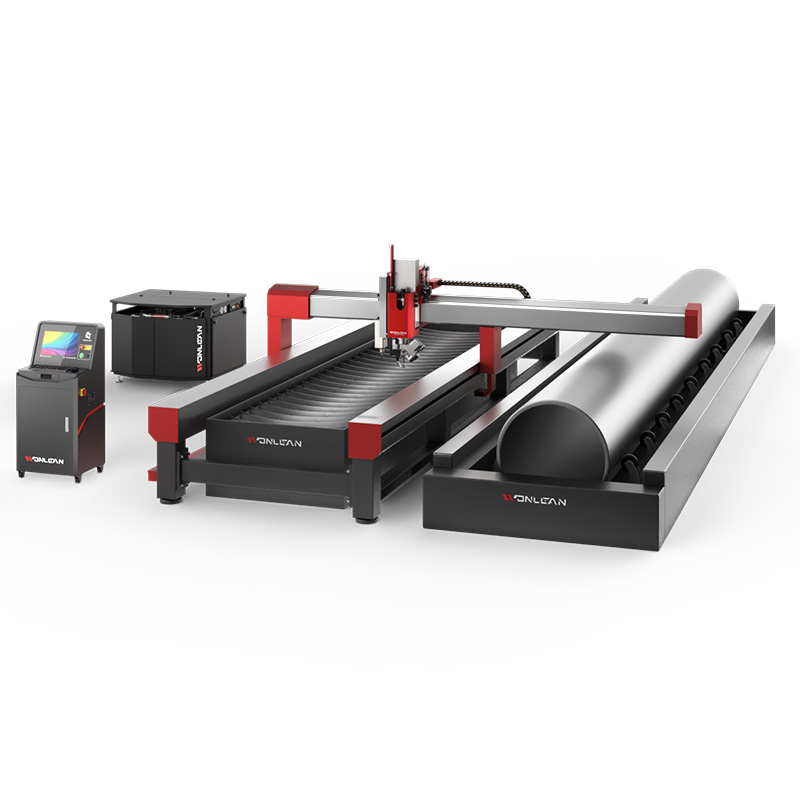
Fabricators often need to process structural tubes and pipes alongside flat plates. Utilizing a sheet and pipe waterjet cutting machine integrates a rotary axis attachment directly onto the cutting bed. This expands capabilities significantly without requiring a separate dedicated machine.
Rotary attachments on waterjets compare favorably to dedicated tube lasers when processing thick-walled pipes. Tube lasers struggle with thick walls and reflective materials just like flatbed lasers. A waterjet rotary axis can cut complex 3D profiles, intersecting joints, and holes in thick structural tubes without any heat distortion. This is vital for heavy equipment manufacturing, structural steel fabrication, and custom architectural metalwork. You can cut a perfect saddle joint in a 0.500-inch wall aluminum pipe without melting the edges.
Strategic value lies in versatility. Fiber lasers are highly specialized tools. They cut metal rapidly, but they only cut metal. If a client asks you to cut carbon fiber or bulletproof glass, you have to turn the job down. A waterjet is entirely material agnostic.
You can pivot from cutting 4-inch steel armor plating to cutting bulletproof glass, thick rubber gaskets, or carbon fiber panels in the exact same shift. You only need to adjust the pump pressure and abrasive flow rate. This versatility allows small to medium shops to diversify their client base. You can serve the aerospace, architectural, and automotive sectors simultaneously with a single machine. When the metal fabrication market slows down, you can take on stone cutting or composite work to keep the machine running.
Installing heavy industrial machinery requires careful facility planning. Both lasers and waterjets have specific environmental and maintenance requirements. You must prepare your shop floor to handle the unique demands of the technology you choose. Ignoring these requirements leads to excessive downtime and maintenance headaches.
Laser systems require a steady supply of assist gases, primarily nitrogen and oxygen. You must manage bulk gas storage tanks or install expensive nitrogen generation systems. Lasers also consume protective windows and copper nozzles regularly. High-kW lasers draw significant electrical power, requiring robust electrical infrastructure, often demanding 480V 3-phase power drops with high amperage ratings.
Waterjets rely on abrasive garnet. Garnet is the highest ongoing consumable requirement. You need a reliable supply chain for high-quality abrasive to prevent clogging in the cutting head. Routine maintenance involves replacing mixing tubes, jewel orifices, and high-pressure pump seals. You must also account for continuous water usage during operation. Operators must be trained to rebuild the high-pressure pump seals at regular intervals to maintain peak cutting pressure.
Fiber lasers pose severe eye safety risks due to the invisible wavelength of the beam. They require fully enclosed cutting cabins with specialized safety glass. You must install heavy-duty fume extraction systems to remove hazardous metallic dust and smoke generated during the melting process. Lasers also require large chiller units to maintain optimal operating temperatures for the power source and cutting head.
Waterjets do not create hazardous fumes or smoke. The water traps the dust, making it a much cleaner process for the ambient shop air. However, you must manage the water and the spent abrasive. Facilities require water treatment or recycling systems to handle the overflow and maintain proper pH levels before discharging to the sewer. You must also implement a system for abrasive removal and disposal. The tank fills with garnet sludge and metal kerf, which requires regular excavation and proper environmental disposal. Acoustic considerations are also necessary, as the supersonic water stream generates significant noise when cutting above the water line.
Choosing between a laser and a waterjet comes down to the physical realities of your daily production. Lasers are the undisputed choice for high-speed, high-volume production of thin sheet metals. However, for materials exceeding 1 inch, or for operations requiring zero thermal distortion and broad material versatility, the waterjet is superior. To move forward with optimizing your fabrication capabilities, take the following steps:
Audit your material inventory to determine the exact percentage of plate stock exceeding 1 inch in thickness.
Calculate the monthly labor hours currently spent on secondary operations like grinding dross or machining hardened edges.
Evaluate your facility's infrastructure to ensure you can support water treatment and abrasive disposal.
Request test cuts from manufacturers using your specific thickest materials to physically inspect edge quality and kerf accuracy.
A: Yes. While ultra-high-power fiber lasers can cut steel up to 1.5 or 2 inches, they suffer from severe speed reduction and edge degradation. A waterjet easily cuts metals 10 to 12 inches thick while maintaining a smooth edge and zero thermal distortion.
A: Yes. Lasers use intense thermal energy to melt metal. On thick plates, this heat transfers into the surrounding material, creating a Heat-Affected Zone (HAZ). This process hardens the cut edge, making secondary machining or tapping very difficult without prior annealing.
A: The primary consumable is the abrasive garnet used to erode the material. Other routine consumables include mixing tubes, jewel orifices, high-pressure pump seals, and the water itself. Garnet consumption scales with the thickness and hardness of the material being cut.
A: Absolutely. Waterjets use a mechanical cold-cutting process. They are completely immune to the thermal reflectivity issues that plague laser cutters. A waterjet cuts thick copper, brass, and aluminum just as easily as it cuts carbon steel.
A: On thin sheet metal (under 0.25 inches), a laser is significantly faster. However, on thick plates (over 1 inch), the speed gap narrows. Furthermore, waterjets eliminate the need for secondary edge finishing, often making the overall part-to-completion time faster for thick materials.
A: Generally, a standard industrial concrete floor is sufficient. However, the tank holds thousands of gallons of water and heavy steel plates. You must ensure your floor can support the static weight of the fully loaded machine and the dynamic vibration of the high-pressure pump.